TOMiC is a professional 16-channel Groovebox DAW engineered for complete track production and live electronic performance — combining percussive synthesis, deep sub-bass, melodic leads, chords, modular sound design, sample slicing, and hosted plugins across Techno, Electro, Hip-Hop, Drum & Bass, and Experimental genres. Designed from the ground up in Rust using the nih-plug framework and egui GUI architecture, it achieves ultra-fast DSP rendering with memory safety and rock-solid stability.
The Groovebox DAW Paradigm
Unlike traditional digital audio workstations built around linear multitrack tape timelines, TOMiC is intentionally designed in the tactile, pattern-centric paradigm of a hardware groovebox. It allows producers to sculpt sound from raw physics, compose interlocking basslines and drum grooves, sequence complex polymetric rhythms, jam live with instant performance overrides (FILL), chain arrangements in Song Mode, and bounce a finished, mastered release directly to bit-accurate WAV or multi-track MIDI.
The workstation provides up to 16 independent instrument tracks (8 visible by default; click "+ Add" to create more), each operating as a complete, self-contained instrument (drums, bass, lead, pad, sample, or external plugin) equipped with:
Dedicated Dual Layer (A/B) synthesis engine with real-time continuous morphing
Dual Noise/Sample Generators (NOISE1 + NOISE2) with 12 noise types (inc. Clocked S&H, Cluster, Chiptune LFSR, GrainGlitch, and FilterBank)
Filter chain featuring up to 8 filters and 12 analogue models
Extensive DSP FX chain (distortion, wavefolder, bitcrusher, Stutter/Beat Repeat slicer, chorus, phaser, delay with Dual Delay resonant filters, reverb, spectral gate, Rings Resonator, and more)
Integrated Sample Browser with live waveform audio preview and tree navigation
Hosted Instrument Plugins (Standalone): replace a layer's OSC and/or NOISE section with an external CLAP or Omniplugin synth — up to 4 hosted plugins per channel
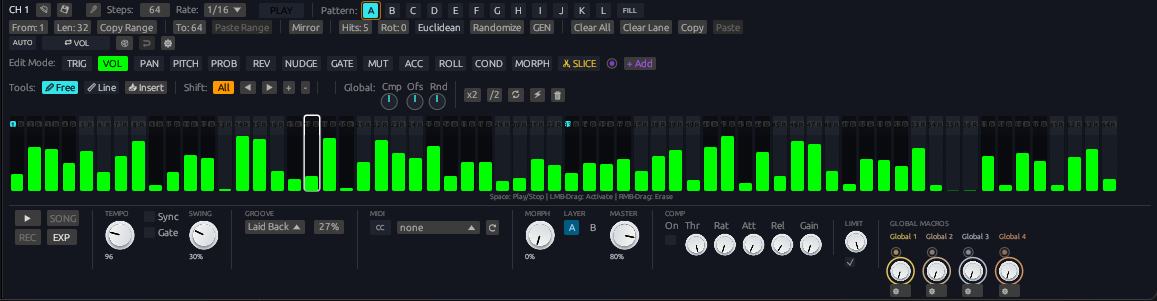
Dedicated step sequencer track with 13 pattern slots (12 lettered banks A-L + a dedicated FILL override slot), Kit-Level Groove Generator, and Modular Pattern Chain Editor
Zoom HD
Main Header Bar & Navigation
Figure 1.1: TOMiC main navigation header bar — Master section, BPM tempo, preset browser, and operating modes.
1.2 Core Features & Capabilities
🎛️ Sound Engine
Up to 16 Instrument Channels (8 visible by default): Each with independent synthesis, FX chain, and sequencer track for drums, bass, leads, chords, or sampled loops
Dual Layer Architecture: Layer A + Layer B with real-time smooth morphing
12 Synthesis Architectures: Mesh 2D (FDTD 2D plate physical modeling with 8-wide SIMD, 5 boundary geometries, dynamic re-strike interference, and live 16×16 modal heatmap), Wave (standard waveforms), Braids (macro-oscillator, selected via the same Wave dropdown), FM, FM+Braids, FM+Plaits, Ring Modulation, Ring+Braids (BraidsRing), Cluster Oscillator, Harmonics (8-partial additive), Granular, and the Plaits macro-oscillator (9 engines: Virtual Analog, Waveshaper, Chord, Wavetable, Speech, Modal Resonator, Analog Bass Drum, Analog Snare Drum, Analog Hi-Hat)
Dual Oscillators: OSC1 + OSC2 with crossfade mixing
Dual Noise Generators: NOISE1 + NOISE2 with dedicated Noise Filter Chain featuring up to 8 filter slots per layer (Freq, Drive, Q, Character, Serial/Parallel routing)
Integrated Sample Browser: Built-in folder tree navigation, live audio waveform preview, favorite folders, and drag-and-drop loading
🎚️ Modulation Matrix
Up to 4 LFOs per layer: 10 shapes (Sine, Triangle, Saw, Ramp Down, Square, Trapezoid, Stepped, Random, Drift, Walk), a Curve knob, One-Shot retrigger mode, up to 15 routing slots each
Up to 4 Mod Envelopes per layer: ADSR with up to 15 routing slots
Up to 4 Marbles per layer: Stochastic CV generator (inspired by MI Marbles)
64 Steps (16/32/64): Per-channel step sequencer with individual track lengths
13 Pattern Slots: 12 regular, lettered pattern banks (A-L) for pattern switching and Song Mode chaining, plus a 13th dedicated FILL slot — a global, unlettered performance-override pattern that temporarily takes over every channel at once and isn't part of the A-L bank chain
Kit-Level Groove Generator (🎲): Generates complete, coherent, interlocking drum grooves across up to 8 channels simultaneously from a single random seed. 7 genre styles (Techno, House, Hip-Hop, DnB, IDM, Trap, Free), Longuet-Higgins metric syncopation weighting, and Poly polyrhythmic micro-offsets.
Modular Pattern Chain Studio (✏): Block-based arrangement studio with draggable ChainBlocks, randomized pattern pools (e.g. [C, D, E]), repeat multipliers (×1, ×2, ×4, ×N), step length overrides, and Ableton-style follow actions.
Song Mode: Pattern chaining into complete arrangements with MIDI export
Embedded & External Browser Modes: View live canvas inside the plugin panel or stream wirelessly to system browser (WebSocket bridge 127.0.0.1) for VJing and OBS
1.3 System Architecture & Real-Time Audio Safety
TOMiC utilizes a strictly lock-free audio processing architecture. The DSP engine never allocates memory on the real-time audio thread, guaranteeing zero buffer underruns and zero latency glitches in DAWs.
Drains Automation/sample-trash events from Audio → updates Song → pushes to TripleBuffer
crossbeam::channel, Arc>
ElevenLabs / AI Gen
HTTP requests, WAV decoding, sample loading (spawned on demand)
crossbeam::channel
Artchemy
WebSocket server (127.0.0.1), Canvas visual rendering
crossbeam::channel, TcpListener
MIDI Input (Standalone)
Reads external MIDI CC/notes via midir, injects into the same atomics a DAW host would use
Atomics, Arc>> (CC map)
Key Design Principles:
🔒 Lock-Free Audio: Zero locks on the audio thread itself (TripleBuffer for state; the write side used by the UI/background threads is Mutex-guarded, but the audio thread only ever reads)
⚡ Zero Allocation DSP: Pre-allocated 64-sample buffer blocks, SIMD optimization via the wide crate's f32x8 lanes (compiled for AVX2 on Windows/Linux release builds, falling back to SSE2 where unsupported)
🧵 Thread Safe: AtomicBool/AtomicU8/AtomicUsize for flags and CC-learn state, Arc\/Arc\ for UI-and-background-owned data
📦 DrumPatch: Flat parameter snapshots copied every block — audio thread never reads Arc\ directly
1.4 Quick Start Guide
Step 1: Synthesizing Your First Drum (CH1 Kick):
1. Channel Selection: Click CH1 on the left sidebar navigation or press 1 on your keyboard.
2. Setup Layer A: Select the oscillator waveform (e.g. Sine for kick), adjust OscEnv Decay.
3. Pitch Envelope: Increase Pitch Mod Amount and set a fast Pitch Hold / Decay for a punchy transient click.
4. Add Noise: Switch to the NOISE tab, select Pink or Metallic noise to add top-end presence.
5. Create Pattern: In the bottom step sequencer, click steps 1, 5, 9, 13. Press Space to start playback!
6. Layer Morphing: Switch to Layer B, configure an alternative sound, and tweak the Morph knob to morph smoothly between layers A and B.
Step 2: Programming a Melodic Bassline or Lead (CH2 Bass):
1. Channel Selection: Click CH2 on the left sidebar or press 2.
2. Setup Tone Engine: Choose Wave (Saw / Triangle) for classic analog sub, FM for metallic punchy bass, or Plaits / Braids for wavetables or chords.
3. Shape Filter & Envelope: Switch to the FILTER tab, pick a Moog 24dB or 303 Diode circuit model, and dial in Cutoff and Drive.
4. Melodic Step Sequencing: In the step sequencer, open the PITCH lane. Select your musical scale (e.g. Minor or Dorian) to lock all note painting to key.
5. Draw Melodic Sequence: Paint steps with varying pitch offsets (e.g. root note, octave jumps, minor thirds), set step velocities, and apply subtle swing or ratchets.
Step 3: Arranging the Full Groovebox Session:
1. Kit Groove Generator (🎲): In the sequencer header bar, click the dice icon to generate instant, interlocking rhythmic and bass arrangements across multiple channels.
2. Pattern Chaining & Song Mode: Use lettered pattern banks A through L to build verse/chorus/drop sections in the Pattern Chain Editor (✏).
3. Live FILL Jamming: Hit the dedicated FILL button to instantly override all 16 channels with a live energetic transition without interrupting groove timing.
1.5 Free Version (v0.1) & Evolution to TOMiC v0.4, v0.5 & v0.6
TOMiC v0.1 is available completely free of charge as an official entry for the prestigious KVR Developer Challenge 2026.
Please note that Version 0.1 is provided as-is as a frozen competition release and will not receive further updates or development. All active engineering, new features, and ongoing support continue in the commercial release of TOMiC.
Key Upgrades in TOMiC v0.6:
🥏 Mesh 2D Physical Modeling Plate Engine: Real-time 2D Finite-Difference Time-Domain (FDTD) biharmonic numerical solver running 8-wide SIMD on both OSC 1 and OSC 2 across Layer A and Layer B. Features 5 boundary geometry masks (Circle, Square, Ellipse, Hexagon, Chladni), dynamic re-strike wave interference (subsequent hits land on an already vibrating plate with zero machine-gun repetition), physical choke and dampening directly into active grid cells, real-time 16×16 modal vibration heatmap, 12 parameters, and 14 dedicated LfoTarget destinations.
🎲 Kit-Level Groove Generator: Single-click full drum kit generation in the Sequencer header (🎲 icon) across up to 8 channels simultaneously from a single random seed. 7 genre styles (Techno, House, Hip-Hop, Drum & Bass, IDM, Trap, Free / Experimental), Longuet-Higgins metric syncopation weighting with kick/snare rejection sampling, interlocking roles, Poly slider (12/24 drift & polyrhythms 3:4, 5:4, 7:4), and production mix staging.
🧱 Modular Pattern Chain Editor: Block-based arrangement studio (✏ icon next to Chain: in Sequencer header) with draggable ChainBlock cards, randomized pattern pools (e.g. [C, D, E]), repeat counters (×1, ×2, ×4, ×N), step length overrides, and Ableton-style follow actions (Next, Previous, First, Last, Jump to Block, Stop, probabilistic branching).
🎛️ Dual Delay Engine: 4th delay engine in the MIX/FX rack featuring alternating series delay lines with global feedback. Odd echoes pass through resonant Filter A and even echoes through resonant Filter B (independent LP/BP/HP, Cutoff, and Resonance), stereo ping-pong width, amber visualizer, and 4 LfoTarget modulation destinations.
🧬 Smart Random 2.0 & Archetype Recipes: 10 instrument archetypes (Kick, Snare, HiHat, Clap, Tom, Percussion, Cymbal, Bass, Drone, FX), 5 sonic profiles (Clean, Analog, Digital, Industrial, Chaos), morph-compatible Layer B sibling generation, and a one-click "🎲 All" kit randomization button in the Tools panel.
🔌 Hosted Instrument Plugins (Standalone): External CLAP and Omniplugin (WASM) synths can now replace a layer's sound source entirely — on the OSC section, the NOISE section, or both, for up to 4 hosted plugins per channel — with 20 modulatable host knobs per slot, automatic knob mapping with pinning, and an Always On mode for self-hosted sequencers.
🎬 Song Mode Clips & Live Chain Growth: Per-pattern Start/Stop Clip memory (a static baseline plus a live-recorded override), plus live chain growth — playing through the pattern chain with REC engaged now appends new positions instead of looping back to the start.
🎯 Bit-Accurate Export & Bounce: Offline rendering now shares its per-block setup with live playback (per-voice BPM, CLAP transport, full master FX chain, Hand-Made curves), three Song Mode automation-recording bugs are fixed, and bounce no longer lets a decay tail re-trigger the sequencer or Solo leak other channels.
🌊 LFO: 5 → 10 Waveforms: Ramp Down, Trapezoid, Stepped, Drift and Walk join the classic five, plus a new Curve knob (log/linear/exponential shaping) and a One-Shot retrigger mode that turns any LFO into a custom envelope.
🛡️ Reliability Pass: A systematic engine audit fixed 8 issues (NaN/Inf sanitization before host output, panic recovery, MIDI CC Learn memory ordering, HTTP client timeouts) with 9 new regression tests, and a long-standing ASIO bug that could leave Standalone completely silent on some drivers (ASIO4ALL, Focusrite, FL Studio ASIO) is fixed.
✂️ Slice "Send To": Right-click any sliced sample region to send just that cut to another channel or Round Robin variant, building a hit bank from a single break.
Key Upgrades in TOMiC v0.5:
🔌 In-Process CLAP FX Hosting (Standalone): Standalone mode hosts external 3rd-party CLAP effect plugins (up to 8 slots per channel and Master bus) with 8 dedicated modulation lanes (ClapMod 1–8), RT-safe 64-sample planar buffers, soft circuit breaker protection, and process-isolated scanning.
🔄 Sequencer Range Ring & Copy Range Workflow: Dynamic draggable ribbon above the active step matrix for instant loop windowing, sliding, and correlated Copy/Paste Range staging for lightning-fast pattern fragment cloning on the same channel.
📐 Persistent UI Scaling & Window Geometry Memory: Interface zoom scale (80%, 100%, 125%, 150%) is automatically saved to disk (%APPDATA%\tomic\ui_settings.json) and remembered permanently across restarts.
🎯 Smart Multi-Variant Sample Drag & Drop: Dropping audio samples onto the Noise/Sample pad detects the active variant tab (A, B, C, D) in the Sample Manager, updating that exact variant without overwriting Slot A.
⚡ Offline CLAP Render Integration: Exporting WAV master files, channel bounces, and MIDI tracks now fully renders all loaded CLAP effect racks offline.
💎 UI Polish & Git Commit Hash in About: Expanded About dialog displaying compile-time Git commit hash (Version 0.5.0 ()) and widened mixer strips to eliminate text clipping.
Complete Overview of All Key Upgrades in TOMiC v0.4 vs v0.1:
#### 🎛️ Architecture & User Interface
16-Channel Architecture: Expand beyond the fixed 8-channel kit in v0.1 to up to 16 fully independent instrument tracks (drums, basslines, leads, pads, samples, external synths) with on-the-fly [+ Add] creation.
Dockable Editor Panels: Flexible UI layout with dockable editor sections and layout locking.
Preset Navigation: Per-track factory preset browser with quick prev/next buttons.
Master Bus: Master FX Chain, Master Filter, bus glue compressor, and digital Soft Clipper / Limiter.
#### 🔮 Synthesis Engines & Oscillators
Additive Harmonics Engine: 8-partial additive oscillator with independent waveform shapes (Sine/Triangle/Square/Saw) per partial.
Plaits Macro-Oscillator: A full 9-engine Mutable Instruments Plaits clone (Virtual Analog, Waveshaper, Chord, Wavetable, Speech, Modal Resonator, Analog Bass Drum, Analog Snare Drum, Analog Hi-Hat) as its own selectable synthesis architecture, plus Plaits-style AnalogBD/AnalogHH and Pluck/Blown/FltPk/FltHp physical-model algorithms folded into the Braids oscillator.
Multi-Sample Round-Robin (A/B/C/D): 4 variant sample bank cycling per hit to eradicate machine-gun repetition.
Noise Filter Chain (Up to 8 Slots): Noise filtering elevated to up to 8 filter slots per layer (Freq, Drive, Q, Character, Serial/Parallel).
Direct Sample Granulation: Granulate loaded audio samples directly within the Noise layer.
#### 🎚️ Modulation Matrix & Macros
4× Modulation Capacity: Expanded from 1 to 4 LFOs, 4 ModEnvelopes, and 4 Marbles per layer (15 routing slots each).
7 Physics & Math Modulators: Lorenz Chaos, Markov Chains, Cellular Automata, Tidal simulation, Orbital Mechanics, Chladni plates, CV Granulation.
Performance Modulators: Real-time HandMade gesture recording and 2D XY Pads.
Macro Control System: 7 channel macros + 4 global macros with drag-and-drop cable routing.
#### 🔊 DSP FX & Filter Chains
Chain of Up to 8 Filters: Up to 8 stacked filters per layer (12 analogue models, Serial/Parallel routing per slot).
Clouds Granular Engine in FX: Rust port of Mutable Instruments' Clouds granular firmware (originally C++) embedded in the FX chain (clouds_fx) for stereo post-filter granulation.
Res FX (Rings Resonator): Modal resonator based on Mutable Instruments Rings (Modal, Sympathetic, String modes).