⌨️ Keyboard Shortcuts and Virtual Keyboard
[!TIP]
Tip: All default keyboard shortcuts in Omni DAW are chosen so as not to conflict with the virtual QWERTY MIDI keyboard. At any time, you can press F12 to bring up a help overlay with shortcuts inside the program. Most shortcuts (the GlobalAction map) can be remapped in the Settings window.
🖥️ 1. Navigating Panels and Views
Session View ↔ Arrangement View
Toggles between the non-linear clip grid in the Session View and the classic timeline in the Arrangement View.
Device & FX Panel
Opens the bottom panel for devices, synthesizers, plugins, and effect chains on the selected track.
Clip Editor / Piano Roll
Slides out the editor for the active note clip, step sequencer, or Drum Machine grid.
Browser Panel
Shows or hides the side browser for samples, presets, effects, and plugins.
Plugin GUI Window
Opens the native graphical user interface window of a VST3 / CLAP / LV2 / VST2 plugin on the active track.
Shortcuts Overlay
Displays an on-screen overlay with a cheat sheet of all keyboard shortcuts within the program.
Master Console
Expands the full-size mastering mixer console with signal level meters.
Close / Exit
Closes the active bottom panel, deselects objects, or exits Key Map Mode.
🎛️ 2. Device Sub-tabs and Editor Modes
Piano Roll Mode
Switches the clip editor to edit MIDI notes on the time grid.
Step Sequencer Mode
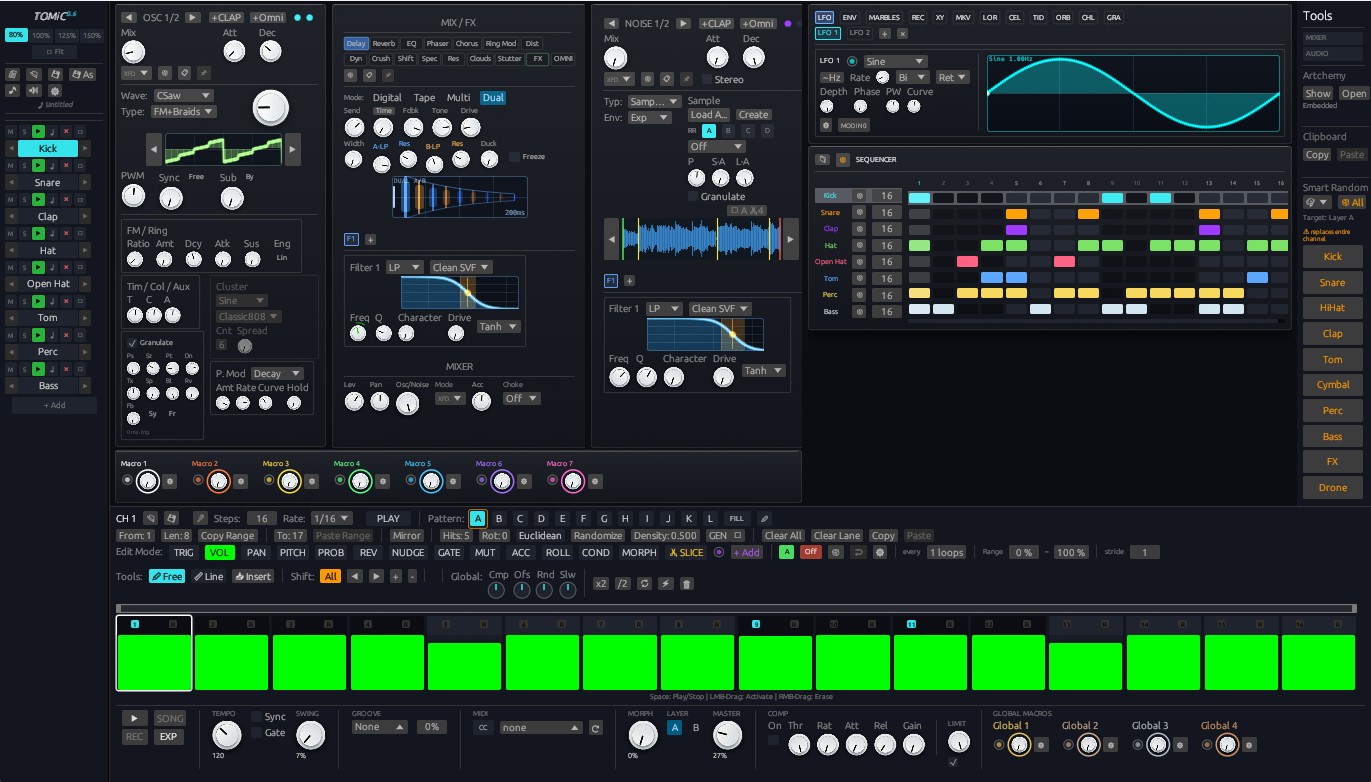
Switches the clip editor to a step sequencer with per-step expression lanes.
Euclidean Pro Mode
Switches the editor to an 8-channel Bjorklund polyrhythmic sequencer.
Device Sub-Tab 1..6
Quick jump to device sub-tab 1 through 6 in the effect chain.
Previous / Next Tab
Moves to the previous or next device tab on the track.
⏯️ 3. Transport, Playback, and Project
Start / Stop Playback
Starts or stops playback of the track from the current time indicator.
Undo
Undoes the last performed operation in the project.
Redo
Redoes an undone operation in the project.
Save Project
Quickly saves the current project state to disk.
New Project
Creates a new, blank project.
Open Project
Opens the file dialog to select an existing project from the disk.
[!NOTE] Recording (Record) and looping (Loop) in the Arrangement View do not have default keyboard shortcuts — you enable them via the transport bar button with the mouse, or assign them to a physical MIDI controller via MIDI Learn (see section 4).
🎙️ 4. Tracks and Live Key Mapping (Key Map Mode)
[!IMPORTANT] Ableton-Style Mapping Mode (Ctrl + K): Press Ctrl + K, click any clip or scene in the Session View, and then press a key on your computer keyboard. From now on, this key will become a physical live trigger for the clip/scene!
New MIDI Track
Creates a new track for synthetic instruments or VST3/CLAP/LV2/VST2 plugins.
New Audio Track
Creates a new track for recording and playing audio.
Key Map Mode
Toggles interactive assignment of clips/scenes to computer keys.
Additionally, transport messages (Play / Stop / Record / Record Stop) can be mapped independently to physical MIDI controllers via MIDI Learn in the transport window.
🛠️ 5. Local Editor Shortcuts
The following shortcuts only work within a specific editor, not globally across the application:
Quantize (Piano Roll)
Snaps selected notes to the current rhythmic grid.
Legato (Piano Roll)
Toggles legato mode for selected/new notes. Has nothing to do with transport looping.
Randomize Selection (Step Sequencer)
Randomizes values in the selected section of the step sequencer.
Regenerate / Randomize (Euclidean Pro)
Regenerates or randomizes the current pattern in the Euclidean sequencer view.
🎹 6. QWERTY MIDI Virtual Keyboard
Don't have an external MIDI controller? Omni DAW turns your standard computer keyboard into a two-octave musical keyboard:
Keyboard Layout:
  Black Notes (Semitones):   [S] [D]     [G] [H] [J]          [2] [3]     [5] [6] [7]
  White Notes (C-D-E-F-G-A-B): [Z] [X] [C] [V] [B] [N] [M]      [Q] [W] [E] [R] [T] [Y] [U] [I]
  Octave Register:           ├────── LOWER OCTAVE ──────┤     ├────── UPPER OCTAVE ──────┤
QWERTY Octave Register Control:
QWERTY Octave Up
Shifts the entire virtual QWERTY keyboard 1 octave higher.
QWERTY Octave Down
Shifts the entire virtual QWERTY keyboard 1 octave lower.
A guide to the top control bar of Omni DAW: Play/Stop, BPM, clip launch quantization, and Swing patterns (MPC 54-71%).
A guide to the Session View, launching clips/scenes, ClipChain & SceneChain, Follow Actions, and 4 editor modes.