🔮 Modulator System and Routing
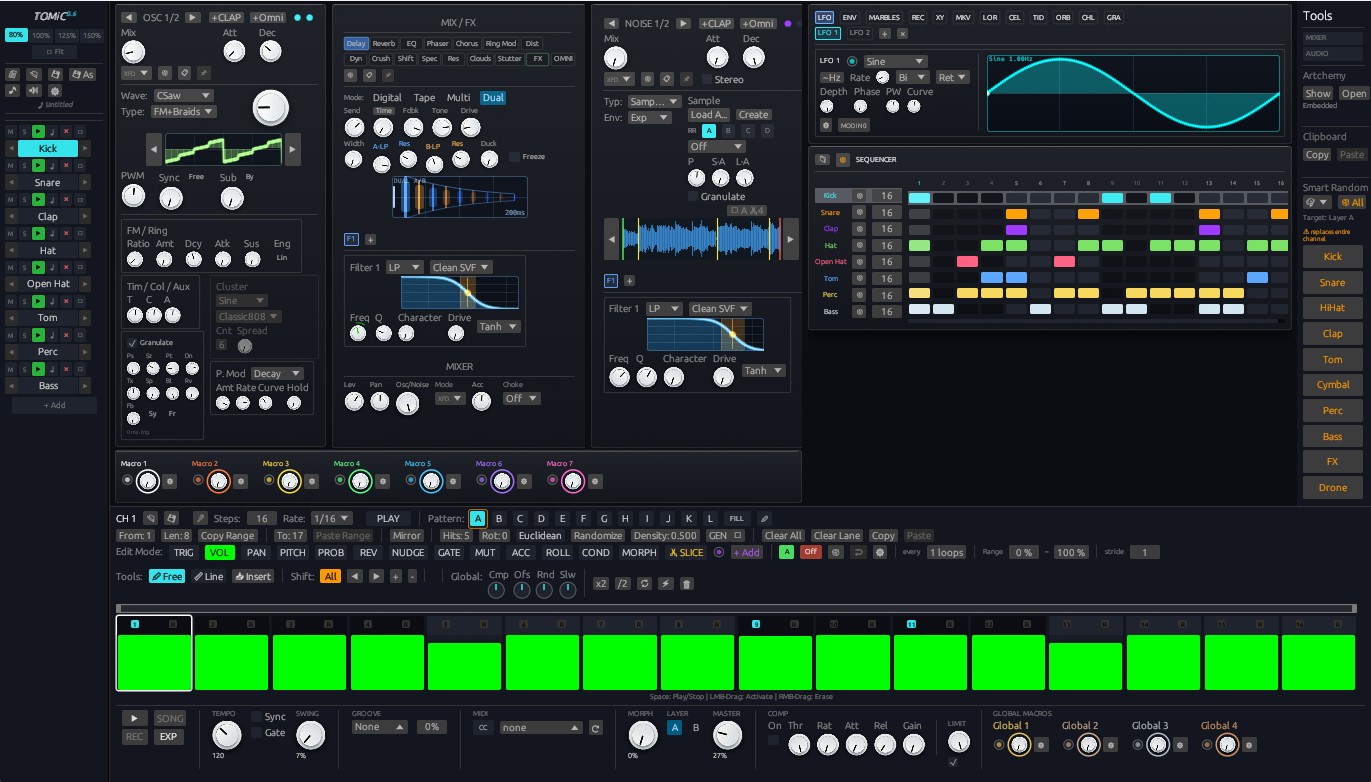
The Omni DAW modulation system allows you to assign any modulator (LFO, envelope, chaotic generator, gravity physics, script...) to any synthesizer, effect, or mixer parameter on a given track.
1. Available Modulators (15 Generators)
1. Classic LFO
A classic low-frequency oscillator with 7 waveforms: Sine, Triangle, Saw, Square, Sample & Hold, Smooth Random, Handmade (the last is a manually drawn 256-point waveform with Hermite interpolation), synced to the project tempo.
2. Macro
A manual, bipolar modulation knob that can be routed to multiple targets simultaneously.
3. ADSR Envelope
A classic envelope triggered by MIDI notes (Attack, Decay, Sustain, Release).
4. Random
A sample-and-hold or smoothed random generator, with an adjustable (or tempo-synced) refresh rate.
5. Marbles
A random generator inspired by the Mutable Instruments Marbles module, providing controlled value scatter.
6. Step Seq
A step-based modulation envelope with optional glide between steps.
7. Markov
"Markov Quantum Engine" — probabilistic state jumping based on a state network, combining sequential movement with random leaps (with adjustable mutation and loop locking).
8. Cellular
A modulator based on a 1D elementary Wolfram cellular automaton.
9. Granular
"Granular Swarm" — a stochastic cloud generator of modulation values.
10. Tidal Drift
A multi-octave, fractal Brownian drift noise — useful for long, evolving ambient textures.
11. Lorenz Chaos
A deterministic Lorenz chaotic attractor generating smooth, organic, non-repeating oscillations.
12. Orbital Physics
A simulation of the gravitational physics of orbiting bodies, receiving a "kick" with every MIDI note-on — producing natural "bounce" and springiness in modulation.
13. Chladni Field
A deterministic generator of 2D standing/interference wave patterns, inspired by Chladni figures.
14. Sidechain Analyzer
The only modulator that responds to a real audio signal from another track — it tracks the envelope, transients, and spectral tilt (ducking effect / pumping filtering to the rhythm of, e.g., a kick drum).
15. Script
A modulator running a custom OmniScript file (.omfx, @mode: modulator mode) — allowing you to write any modulation algorithm. It is added via a separate "📜 Script..." button (file selection), not from the list of the other 14 types.
2. Modulation Assignment and Routing
Each track has its own modulator rack. Assigning modulation to a parameter is done in two ways:
- Drag & Drop: Grab the handle on the modulator card header in the rack and drag it to the target knob/slider — the connection is drawn as a dangling, animated cable with magnetic snap to the target.
- Context Menu on the Target Parameter: Right-click the knob/slider you want to modulate and select "Add Modulation" → Existing (connect an already existing modulator) or New (create a new modulator of the selected type and connect it immediately), or "📜 Script..." for a custom script.
A colored Modulation Ring appears around the modulated knob, showing the depth and direction of the modulation (the color matches the modulator card in the rack). Multiple modulators can target the same parameter simultaneously — their contributions are summed, and the modulation rings are stacked next to each other to avoid overlapping.
A guide to the 16 native effects in Omni DAW: EQ, Filter, Compressor, Gate, Delay, Reverb, Convolution Reverb, Granular Clouds, and more.
A comprehensive guide to all built-in synthesizers in Omni DAW: Alchemical Synth, PolySynth, BassSynth, Iris (image-to-sound), TOMiC Drum Synth, Piano, and Physical Modeling Suite.