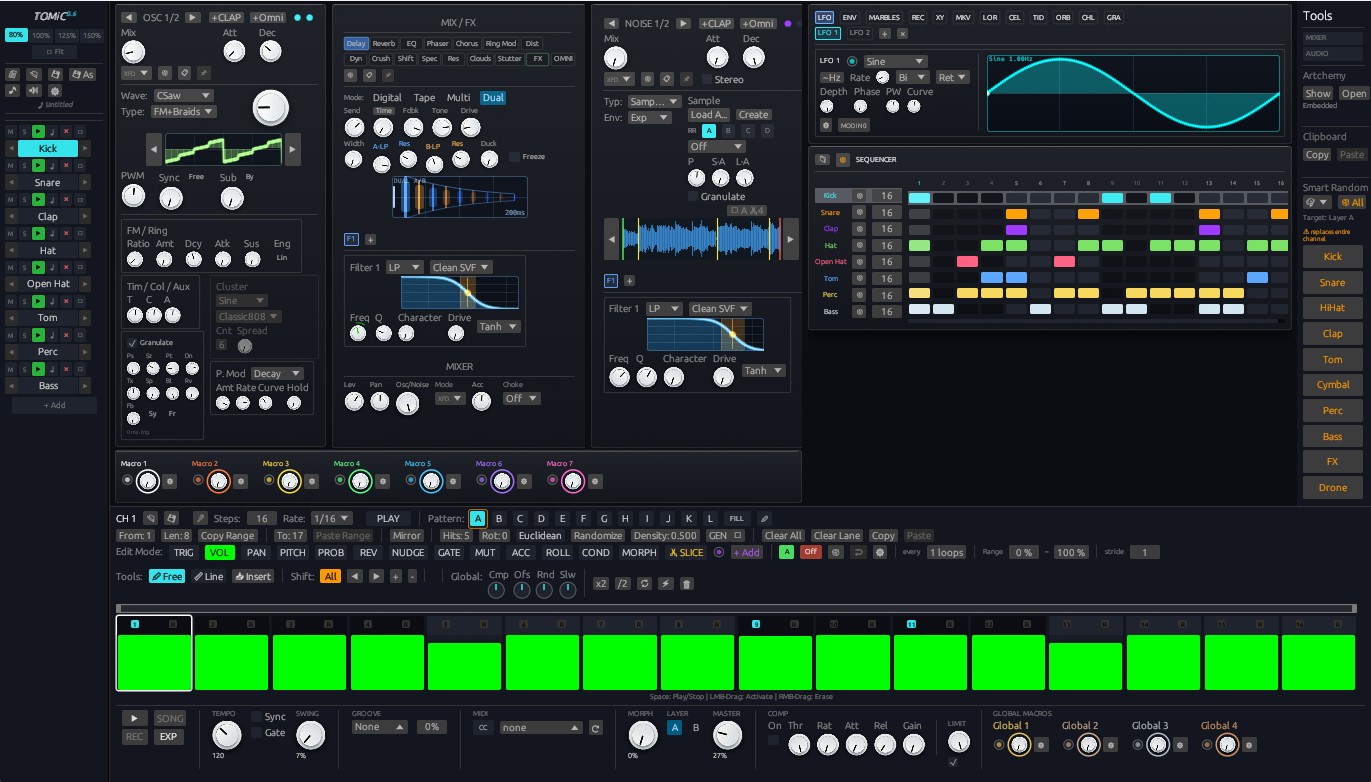
🎚️ Mixer, Channel Strips & MIDI Routing
The Mixer in Omni DAW is the heart of audio signal summing and balance control in your project. It offers precise adjustment of volume, stereo panning, FX bus sends, and advanced options for routing MIDI notes to external hardware synthesizers.
1. Channel Strip
Each track in the mixer has its own vertical channel strip equipped with the following controls:
- Volume Fader: Adjusts the signal level from -48 dB to +6 dB.
- Peak Meter: A stereo peak+RMS meter with a peak-hold line; upon clipping (above 0 dB), the bar color changes to red.
- Pan: A knob for balancing the signal between the left and right channels, featuring an Equal-Power Panning algorithm (prevents perceived volume changes when panning).
- Trim (Level Tuning): An additional input sensitivity knob (0.0–2.0, meaning -∞ to +6 dB) operating pre-fader — useful for gain staging.
- Mute (M): Mutes the track.
- Solo (S): Mutes all tracks except the selected one.
- Record Arm (Red Button): Arms the track to record the incoming signal.
2. Sends and Returns (Send / Return Routing)
Omni DAW allows efficient workflow with return effects (Return Tracks / FX Busses), such as shared reverb or delay. The number of Return busses is dynamic — you can add as many as you need without a hard limit.
- Send Knobs: Each channel strip features send knobs, one for each existing Return bus. Turning the knob sends a portion of the track's signal to the corresponding effect track.
- Pre / Post Fader Mode: A pre/post toggle for each send is available in the expanded Master Console.
- Post-Fader (Default): The send level changes proportionally to the movement of the track's main volume fader.
- Pre-Fader: The signal is sent to the effect before the volume fader, allowing you to mute the main track while leaving the trailing reverb audible.
3. Master Bus
The Master bus is located on the right side of the mixer and serves as the final summing point for all tracks in the project:
- Master Fader: The main output fader for the project.
- Master FX Chain: A dedicated slot for insert mastering effects, such as a parametric equalizer, master bus compressor, and a brickwall limiter to prevent digital clipping.
- TPDF Dither: Built-in TPDF dithering mechanism for 24-bit and 16-bit outputs, ensuring clean, quantization-noise-free track exports.
4. Hardware MIDI Output Routing
Omni DAW not only controls internal synthesizers but can also act as the brain of a hardware studio:
- Per-Track MIDI Routing: In the MIDI track header, you can select the physical MIDI output port of your interface (e.g., USB MIDI Out).
- Panic Button (All-Notes-Off): In case playback is stopped or looped, the engine automatically sends an All-Notes-Off signal to physical ports, preventing "hanging" or stuck notes on external hardware synthesizers.
A guide to timeline operations, bouncing clips (Bounce to Audio), freezing tracks (Freeze Track), 5 fade curve types, and 5 warp modes.
A guide to the 16 native effects in Omni DAW: EQ, Filter, Compressor, Gate, Delay, Reverb, Convolution Reverb, Granular Clouds, and more.