🔮 Built-in Synthesizers and Instruments
Omni DAW features a rich palette of native synthesizers and built-in instruments, based on physical modeling, FM/PM synthesis, and resynthesis.
1. Alchemy Synthesizer
The Alchemy Synthesizer uses chemical element data from the periodic table as the source for synthesis parameters:
- Atomic Weight: Determines the frequency ratios (FM/PM Ratios) of 4 operators, tuned to Stern-Brocot fractions.
- Valence Electrons: Shape the ADSR envelope times (attack and release).
- Electronegativity: Controls the Modulation Index for FM and the overdrive depth of the wavefolder.
- 4-Operator PM/FM Matrix: 10 DX7-style routing algorithms.
- Braids-style Oscillators: The engine ports approx. 25 macro-oscillator algorithms from the Mutable Instruments Braids module (31 available waveforms in total) as a sound option for operators.
- Blend Modes: 16 operator signal blending modes — Add, Multiply, Screen, Overlay, Difference, Exclusion, Linear Burn, Linear Dodge, Vivid Light, Pin Light, Hard Light, Soft Light, Color Dodge, Color Burn, Darken, Lighten.
- Wavefolder & Feedback Delay Network (FDN Reverb): An anti-aliased (ADAA) wavefolder and an 8-line FDN network with modulated, interpolated (Hermite) delay lines acting as a reverb.
- Procedural Naming: The engine generates procedural patch names based on a Lovecraftian "lexicon" of elements (e.g., combining element names into a compound name) — this is a name generator, not a library of pre-made, named "transmutation" presets.
2. PolySynth (16-Voice Analog Synthesizer)
PolySynth is a 16-voice polyphonic synthesizer designed for analog pads, leads, and basses:
- 2 Main Oscillators + Sub-Oscillator + Noise Generator: Waveforms: Sine, Saw, Square, Triangle, Pulse, SuperSaw (7 micro-layers).
- Oscillator Blend Modes: Blend, FM, Ring Modulation — plus an independent Hard Sync switch.
- True Unison: 1 to 8 voices per polyphonic voice, with adjustable Stereo Spread and Detune.
- 10 Filter Types: Low Pass, LP24, High Pass, Band Pass, Notch, Ladder, Diode 303, Sallen-Key LP, Sallen-Key HP, Comb — with 2× oversampling for non-linear models.
- 10 Overdrive Types: Soft Clip, Hard Clip, Foldback, ArcTan, Tape, Tube, Fuzz, Rectify, Half Rectify, Diode.
- Modulation & Effects: 3 ADSR envelopes, 2 LFOs (6 waveforms), Analog Drift, Juno-style stereo chorus (3 modes), built-in Delay and Reverb.
- Parameter Modulation: PolySynth uses the project's general modulation rack (up to 16 modulators per track, up to 8 routings per modulator) described in
/docs/modulators, rather than a separate, dedicated modulation matrix.
3. BassSynth (Acid & Bass Synthesizer)
BassSynth is a bass synthesizer styled after the Roland TB-303 module. It operates monophonically by default but also supports polyphonic mode up to 8 voices with note priority selection:
- 2 Oscillators + Sub + Noise: Waveforms Sine, Saw, Square, Triangle, SuperSaw, Pulse (PWM), plus a sub-oscillator and a noise generator.
- Multi-model Filter Section: A TB-303 style diode filter (Diode 303, 24 dB/oct) alongside SVF models (LP12/LP24/HP/BP/Notch) and a Moog ladder filter — with Cutoff, Resonance, and Env Mod knobs.
- Accent & Slide (Portamento): Automatic note accenting with dynamic filter jumps and smooth pitch sliding.
- Built-in Drive & Chorus Section: Pre/post-filter saturation and a Juno-style stereo chorus/ensemble.
- Custom Modulation Matrix: BassSynth has a dedicated modulation matrix (8 sources × 12 destinations), independent of the track's general modulation rack.
4. Iris (Image-to-Sound Synthesizer)
Iris is not a classic wavetable synthesizer — it is an image-to-sound resynthesis engine:
- An image (generated by AI or loaded by the user — see
/docs/ai-generation) is "baked" into an additive Spectral Table: the image width corresponds to the number of frames over time, and the height corresponds to the number of harmonic partials. - The pitch of the played note transposes the frequencies of the baked partials.
- Two independent Scan Heads read the table along the timeline in Linear, PingPong, or Spiral modes.
- The R/G/B channels of the image control three parallel modulation paths: amplitude, spectral tilt, and stereo panning.
The sonic result is similar to classic wavetable synthesis (smooth transitions and spectral scanning), but the underlying mechanism is image resynthesis, not the playback of pre-made wavetables.
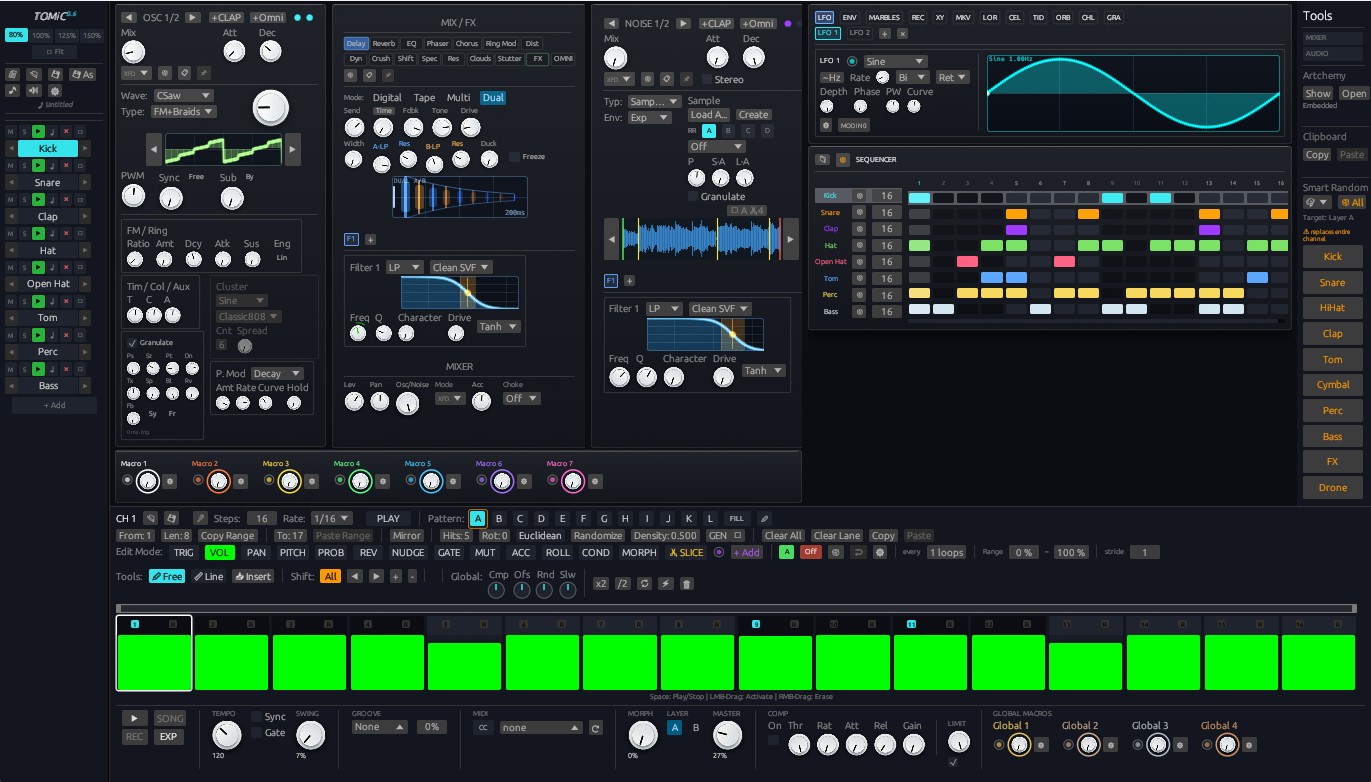
5. TOMiC Drum Synth (Virtual Drum Machine)
TOMiC is a drum synthesizer based on physical modeling:
- 8-Pad Drum Grid: Default pad archetypes are Kick, Snare, HiHat, Bass, Tom, Percussion, Cymbal, FX — each with its own synthesis engine.
- Physical Modeling: Adjustable hammer strike, sub-tone purity, decay, and saturation depending on the pad archetype.
- Smart Randomizer: 6 kit randomization profiles (Random, Clean, Analog, Digital, Industrial, Chaos) that generate a new kit with a single click.
6. Piano (Physical Modeling Piano)
Piano is a physical model of a concert grand piano (felt hammer striking strings + coupling with the soundboard), without using sample libraries:
- Hammer and String Modeling: Each note is simulated as a set of multi-string (unison) voices.
- Sympathetic Resonance: A bank of 8 additional sympathetic resonance voices (neighboring strings in an octave, fifth/12th, octave down), activated by the sustain pedal.
- Expression Pedals: Full support for the Sustain pedal (CC64), Sostenuto (CC66), and Soft / Una Corda pedal (CC67).
7. Physical Modeling Suite
A set of seven distinct synthesizers based on various physical modeling techniques — not all use the same algorithm:
- Guitar Synth & Plucked Synth & Harp Synth: An extended Karplus-Strong algorithm (with a dispersive all-pass filter and body resonance) — simulating plucked guitar strings, acoustic instruments, and the harp.
- Violin Synth: A waveguide string model (in the style of the STK library) with modal body resonance — simulating bowing friction on strings.
- Flute Synth & Reed Synth: Waveguide wind models (a port of the Flute and Reed models from the STK library) — simulating airflow in a flute and reed vibrations (clarinet/saxophone).
- Modal Synth: An additive modal resonator bank for bell and tuned percussion sounds.
A guide to the modulation matrix in Omni DAW: 15 modulation generators (Lorenz Chaos, Granular, Markov, Orbital Physics, Chladni Field, Marbles, and more).
A guide to the ScratchDeck player, ElevenLabs Sound FX integration, audio waveform editing, transient detection, and Slice-to-MIDI.