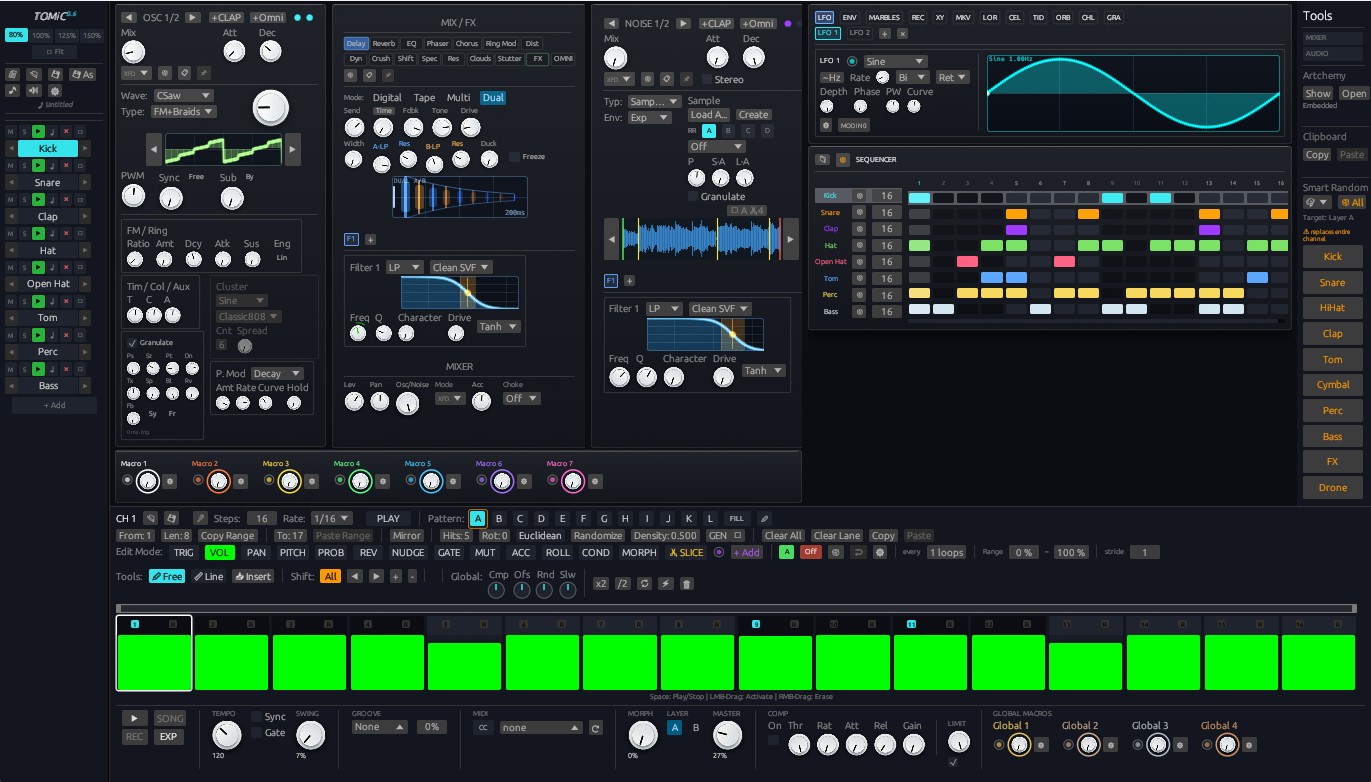
🎹 Session View, Chains & Sequencer Modes
Session View is a non-linear work environment in Omni DAW. It allows you to create, improvise, and trigger audio loops and MIDI sequences as a matrix of clips and scenes, with support for automatic chaining and follow actions.
1. Clip Grid and Scene Launching
The grid in the Session View consists of vertical Tracks and horizontal Scenes:
- Clip Slot: Each slot on a track contains an individual clip.
- Single click launches or queues a given clip.
- Double click selects the clip and opens its editor (Clip Editor).
- Queued Triggering: A pulsing slot color means the clip has been queued.
- Scene Header & Master Trigger: Pressing a scene launch button triggers all clips in that horizontal row simultaneously.
- Clip Launch Mode: A toggle on the Session View toolbar has two values — Next Loop (default: the clip starts after the currently playing clip on that track finishes its loop) and Immediate (the clip starts instantly). There is no selectable rhythmic grid like "every bar / every 1/4" — see details in
/docs/toolbar. - Clip/Scene Color: Each clip or scene can have its own color (context menu, right-click); if a clip has no color, it inherits the scene's color, and then the track's color.
- Drag and Drop: Audio samples and pre-made MIDI progressions can be dragged directly from the browser onto a clip slot.
- Stop All Clips: A global button stopping all playing clips at once (can be mapped to a controller via MIDI Learn).
2. Clip Follow Actions & Chaining (ClipChain & SceneChain)
Omni DAW features a Chain Settings window, allowing you to program automatic transition sequences without user intervention.
A. Follow Actions
Follow Action is active when ClipChain is not active for a given clip (the chain has priority). Available actions:
- Loop: Continuous looping of the same clip (default mode).
- Stop: Stops track playback after the clip ends.
- PlayNext / PlayPrevious: Automatic jump to the next or previous clip on the track.
- PlayFirst: Return to the first clip on the track.
- PlaySpecific: Jump to a specifically indicated clip.
- PlayRandom: Random selection of the next clip on the track.
B. Chain Engine (ClipChain & SceneChain)
In the Chain Settings window, you can build complex playback sequences of clips (ClipChain) or entire scenes (SceneChain — uses the same playback modes mechanism):
- Chain Playback Modes:
Sequential: Step-by-step consecutively (default).Random Step: Each cycle randomly picks one step.PingPong: Back and forth (pendulum sequence).Reverse: Playback backwards from the last step.Brownian("Drunk Walk"): Each cycle moves randomly by ±1 step or stays in place.
- Step Repeat Multiplier (Repeat Count ×1–×16): How many times a step repeats before moving forward (global or per-step setting).
- Step Probability (0–100%): Chance of playing or skipping a step in the chain.
3. Sequencer Architecture: 4 Clip Modes
A sequencer is assigned individually to each clip. In the Clip Editor window, you can choose one of 4 working modes:
┌────────────────────────────────────────────────────────────────────────┐
│                          CLIP EDITOR                                   │
│  [ PIANO ROLL ]  [ STEP SEQUENCER ]  [ EUCLIDEAN PRO ]  [ DRUM MACHINE ]│
└────────────────────────────────────────────────────────────────────────┘
1. PIANO ROLL Mode
- Classic MIDI editor on a time grid (see chapter
/docs/piano-roll).
2. STEP SEQUENCER Mode
- A step sequencer with a dynamic, unlimited number of steps and adjustable grid resolution: Quarter (1/4), Eighth (1/8), Eighth Triplet, Eighth Dotted, Sixteenth (1/16), Sixteenth Triplet, ThirtySecond (1/32), ThirtySecond Triplet, SixtyFourth (1/64).
- Each step features expression lanes: Pitch, Velocity, Gate, Probability, Nudge, Slide, Ratchet, Accent and Elektron-style step conditions (Step Conditions):
PRE,!PRE,FILL,!FILL,X:Y(e.g., 1:2, 2:3),50%(coin flip),1ST,!1ST. - Supports 4 independent pattern banks A/B/C/D per clip.
3. EUCLIDEAN PRO Mode
- An algorithmic polyrhythmic loop generator equipped with 8 independent channels (CH 1–8) based on the Bjorklund algorithm.
- Allows you to set the number of steps (Steps: 1 to 64), number of beats (Pulses), phase offset (Offset), and playback direction per channel (Forward, Backward, PingPong, Random, Each 2nd, Each 3rd, Each 4th).
- Offers smooth morphing of 4 banks A/B/C/D, combinatorial logic operators (AND, OR, XOR, AND-NOT), and 4 dedicated LFOs modulating channel parameters.
4. DRUM MACHINE Mode
- Transforms a single clip into a multi-pad drum machine.
- Each drum pad has its own step lane ranging from 1 to 64 steps, with an independent audio sample or MIDI note assigned to the pad (if a pad has no custom sample, it plays the default MIDI note of the synth/sampler on the track).
4. Pattern Banks (Pattern Banks A/B/C/D)
Four independent pattern banks A/B/C/D apply to the Step Sequencer mode (one set of 4 banks for the whole clip) and Euclidean Pro (4 banks per channel, with smooth morphing). In Drum Machine mode, each pad has its own independent set of A/B/C/D banks. The Piano Roll mode does not use the pattern bank system.
A comprehensive guide to keyboard shortcuts in Omni DAW: navigating panels, transport controls, editor modes, Live mapping, and the QWERTY MIDI virtual keyboard.
A comprehensive guide to the Piano Roll MIDI editor in Omni DAW: 4 editing tools, 10 note expression lanes, Chop division, Scale Fold, and chord theory.